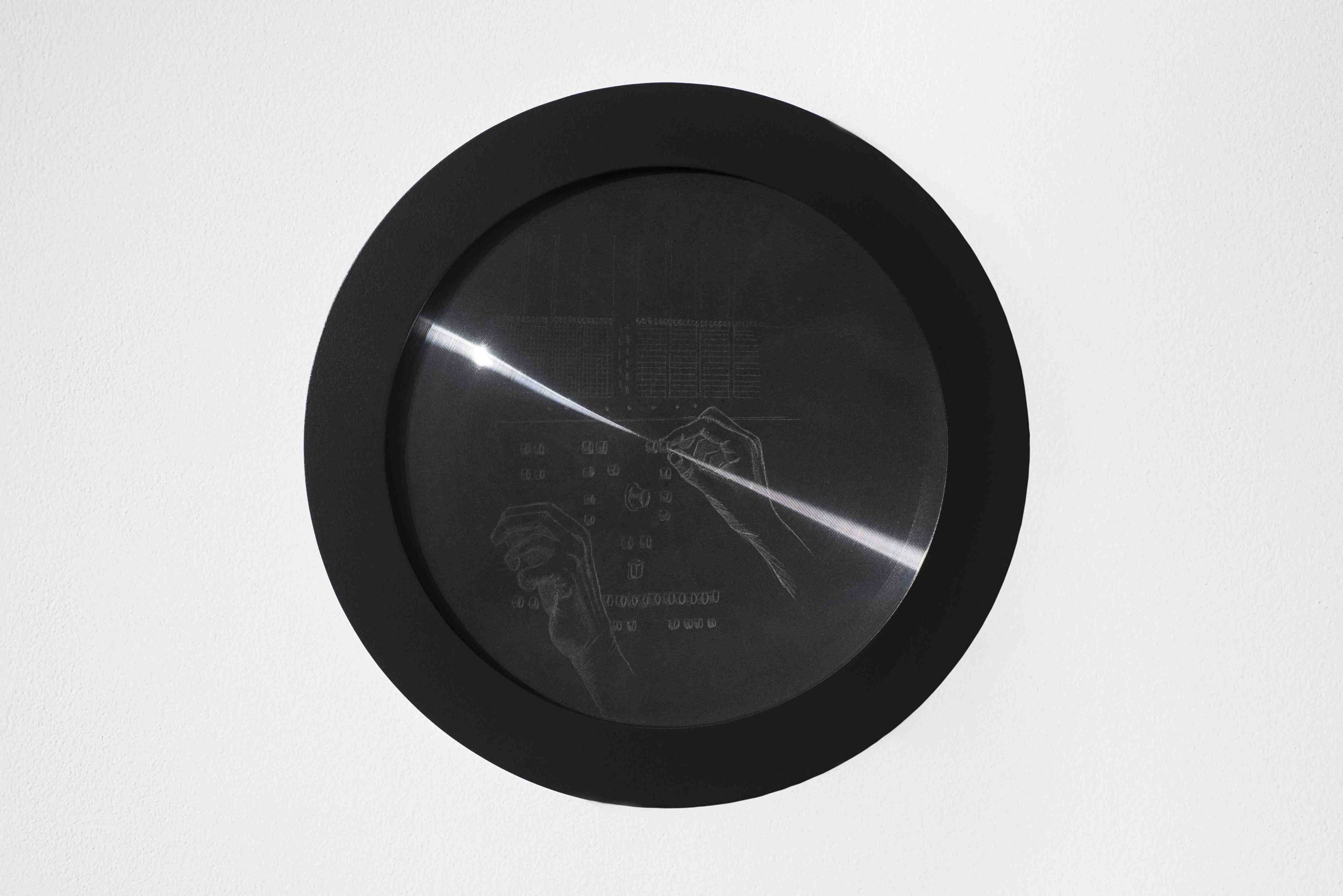
 Aura Satz, 'She Recalibrates' (Elieane Radigue), pencil on black paper, framed with lenticular magnifying sheet, 2018. Photo by Thierry Bal
 'She Recalibrates' (2018) are a series of drawings of hands of women who contributed to the development of electronic music, including Pauline Oliveros, Laurie Spiegel, Eliane Radigue, Delia Derbyshire, Daphne Oram, Maryanne Amacher, Suzanne Ciani, Wendy Carlos, Beatriz Ferreyra and more. The hand on the frequency dial of an electronic synth is interpreted as a radical gesture of feminist instantiation, inventing new soundscapes, and, in turn, new ways of listening. The dial becomes an emblem for recalibration, an indicator of the micro-perceptual act of sound-making and fine-tuned listening. Drawn in pencil on black paper, the drawings are framed with lenticular lenses, generating a diffractive pattern emanating from the dial. The drawings create optical reflections much like those found on a CD or vinyl record, interfering with the image whilst appearing to generate a rotating beam of light from the centre that adjusts to the movement of the viewer. The drawings rely on archival images primarily from the 1960s -1980s, where the composer is shown in a state of acute concentration, hand on the dial or control button, changing the parameter ever so slightly, fine-tuning the sound in a listening feedback loop. For the most part, these sonic interfaces were tentatively held together as modular synthesizers, various hybrid components feeding into one another, modulating or interfering with one another, in such a way as to suggest an unstable musical instrument, one that can be harnessed by a slow, intense and profound act of attunement.
Framed by Simon Quinn at Framejunkie. Photos by Thierry Bal.
'Listen, Recalibrate'
Solo show at Fridman Gallery, New York
Exhibition catalogue with essays by Christoph Cox, David Crowley, Barbara London, and Aura Satz in conversation with David Toop.
fridmangallery.com fridmangallery.com/listen-recalibrate'FIGURE/S: drawing after Bellmer'
group show at The Drawing Room, London
FIGURE/S: drawing after Bellmer explores the body as a site of oppression, liberation and troubling pleasures through the work of modern and contemporary artists. It takes as its starting point the radical and transgressive drawings of Hans Bellmer (1902-1975), whose work simultaneously mimicked and resisted the dehumanisation performed by fascism and racism. His drawings have had a powerful influence, sometimes subterranean, on many artists across the world in both high and popular culture, from French Surrealism to Japanese manga. Recently there has been an upsurge of interest in his work, especially the drawings, by younger contemporary artists.
The exhibition explores Bellmer's lasting influence on artists and thinkers through work by twenty modern and contemporary artists from Japan, UK, Lebanon, Nigeria, Germany, France and US. It includes carefully selected drawings made by Bellmer in the 1940s to 60s, by his partner Unica Zurn in the 1960s, by Richard Hamilton in the 1950s and by the Lebanese artist Huguette Caland in the 1970s.These modern works are combined with contemporary approaches that relate to feminism, gender fluidity and anti-racism, including new commissions by Mathew Hale, Rebecca Jagoe, Aura Satz and Marianna Simnett. Bellmer's influence in Japan is represented by the work of Fuyuko Matsui, Kumi Machida and Tabaimo and the exhibition also includes Paul Chan, Neil Gall, Sharon Kivland, Jade Montserrat, Jean-Luc Moulene, John Murphy, Paul Noble, Wura-Natasha Ogunji and Chloe Piene.
Bellmer grew up with the rise of National Socialism in Germany, with its antagonism towards 'degenerate' bodies and celebration of the ideal human form. Through the production of hundreds of drawings and the two dolls he constructed in the early 1930s and photographed in disturbing and scandalous scenarios, Bellmer defigured and refigured the body in pursuit of unimagined sensations. He likened the body to a sentence that can be dismantled and recomposed, an interest shared with Unica Zurn, the artist, poet and writer who had a relationship with Bellmer from 1953 until her premature death in 1970. For drawings 'after' Bellmer, the phallocentric focus of his enquiry is superseded by approaches that challenge and split the subject to embrace multiplicity and creaturely freedom. Bellmer wrote: 'If the origin of my work is scandalous it is because, for me, the world is a scandal'. His work has continued to scandalise and this exhibition takes a critical look at its content whilst acknowledging Bellmer's innovative production of ambiguous and disturbing images that have renewed significance today in their exploration of androgyny and confusion of the real and the virtual.
A programme of talks, panel discussions and performances will enrich and expand discourse and research around the issues raised by the exhibition.
ON FIGURE/S: drawing after Bellmer is a book published by MA BIBLIOTHEQUE as a companion to the exhibition. It gathers responses to its themes and is a way to think through and with works of art and their histories involving multiple textual forms, collage, and drawing, which take the radical and transgressive energy of Bellmer and Zurn in unexpected directions. Edited by Kate Macfarlane, Michael Newman, Sharon Kivland and Louis Mason, its 29 contributors include Paul Buck, Jade Montserrat, Bernard Noel, Francesco Urbano Ragazzi, Aura Satz and Sarah Wilson. FIGURE/S: drawing after Bellmer is curated by Michael Newman (Professor of Art Writing, Goldsmiths, University of London) and Kate Macfarlane (Co-director, Drawing Room). An art historian and critic, Newman has written extensively on contemporary art, and has a long-standing interest in drawing, with numerous publications, including 'The Traces and Marks of Drawing' in The Stage of Drawing: Gesture and Act (Tate Publishing and The Drawing Center, 2003). He has been researching Bellmer for six years and teaching his work in relation to contemporary art.
drawingroom.org.uk mabibliotheque.cargo.site'She Recalibrates' - Solo exhibition at ARTIUM
Museo Vasco de Arte Contemporáneo, Vitoria-Gasteiz, curated by Garbine Ortega
Aura Satz's film and sound works are made in conversation and use dialogue as both method and subject matter. The works included in this show are part of a long-standing interest in compositional practices, in particular those of women in electronic and electroacoustic music. In addition to three film-sound portraits, the exhibition includes a series of drawings centred on early modular synthesizer compositional practices by women.
In Z Gallery programme, Aura Satz presents the films 'Oramics: Atlantis Anew,' 'Little Doorways to Paths Not Yet Take' and 'Hacer una diagonal con la musica,' three works based on three pioneers in the field of electronic music. 'She Recalibrates' (2018) are a series of drawin fine-tuning the sound in a listening feedback loop.
*Hacer una diagonal con la musica*. 2019. 10 min. A short film about Argentine electroacoustic composer Beatriz Ferreyra, a pioneer of musique concrete together with Pierre Schaeffer during the 1950s and 1960s. Here she discusses her 'sound hunting' recording techniques, and other thoughts on sound montage and spatialization, illustrated through onomatopoeia and dynamic hand gestures. In the key opening scene, Ferreyra is seen listening to the miniscule creaks produced by a door, expanding the simple binary of open vs closed to encompass an entire sound universe, an expanded bandwidth of what can be heard and how we might listen.
*Oramics: Atlantis Anew*. 2011. 7 min. Conceived as an artist's film that pays tribute to Daphne Oram, pioneer of British electronic music and co-founder of the BBC Radiophonic Workshop in 1958, the film depicts a close encounter with her unique Oramics machine invention, housed in the Science Museum in London.
*Little Doorways to Paths Not Yet Taken*. 2016. 8 min. Following Satz's earlier films about women composers and inventors of electronic music, this short film offers an intimate look into the studio of American composer Laurie Spiegel (b. 1945). Renowned for her electronic music compositions and algorithmic composition software, the film also reveals all manner of musical and technological paraphernalia, ranging from sheet music to DIY inventions and collections of quirky toys. The soundtrack features electronic music composed by Spiegel and Laurie's voiceover reflecting on electronic music and the process of composing.
The* Z Gallery* (Z for zinema, cinema in Basque) programme is neither a season of films nor an exhibition. It is a project that constructs an intermediate space from which to reflect on and draw attention to works by artists making the leap into the cinematographic field as well as filmmakers exploring the exhibition format. It is a programme arising from the determined gesture of thinking about the moving image in the museum. A programme that aims to bring to the public authors interested in searching for new narrative forms by questioning the genres that historically categorise cinematographic language. Curator: Garbine Ortega
Catalogue includes newly commissioned essays by Jo Hutton and Xabier Erkizia.
artium.eus artium.eus/en/activities/item/61328-conversacion-con-aura-satzInterview in Elemmental Magazine aura-satz-entrevista
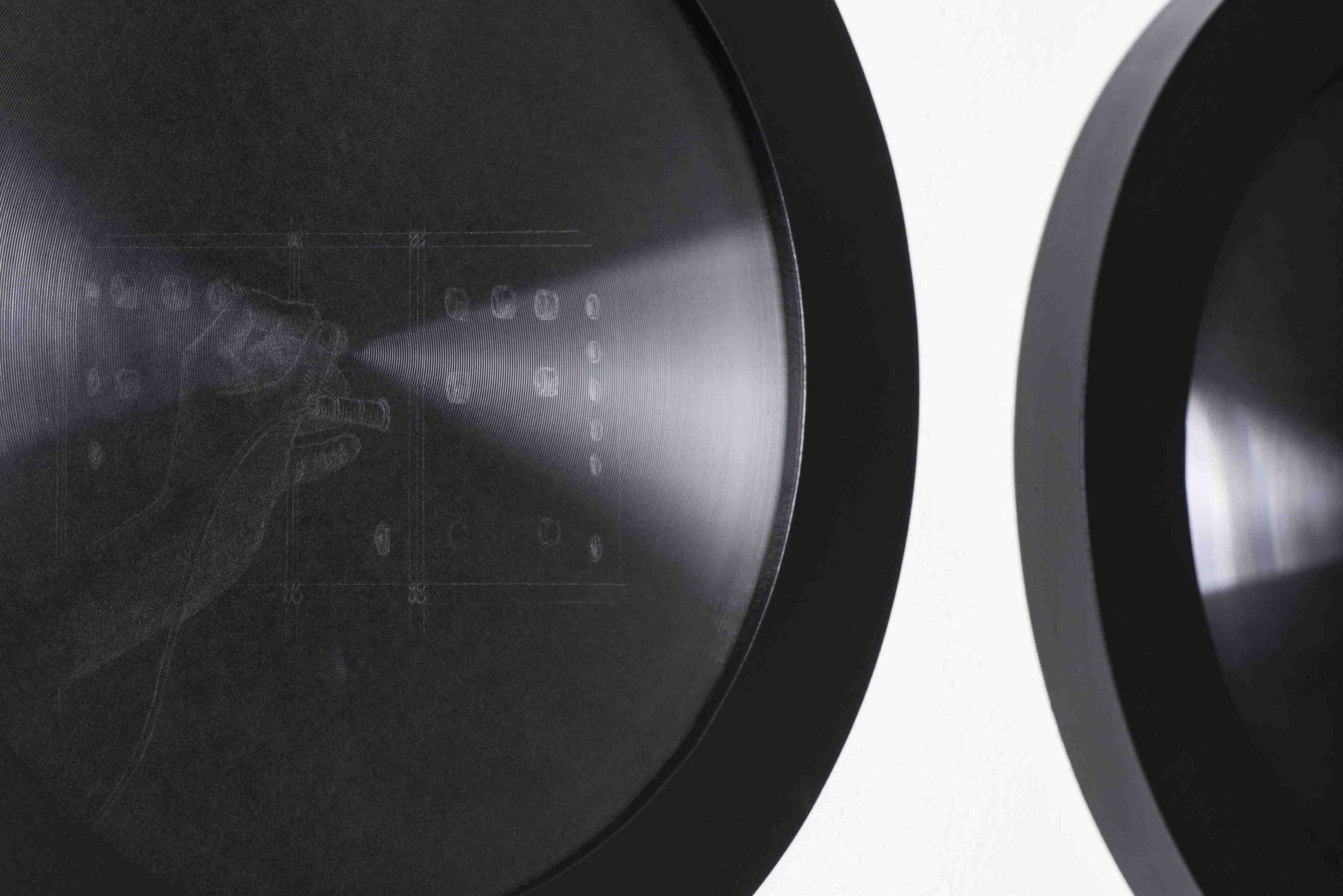 Aura Satz, 'She Recalibrates' (Tara Rodgers, close-up), pencil on black paper, framed with lenticular magnifying sheet, 2018. Photo by Thierry Bal