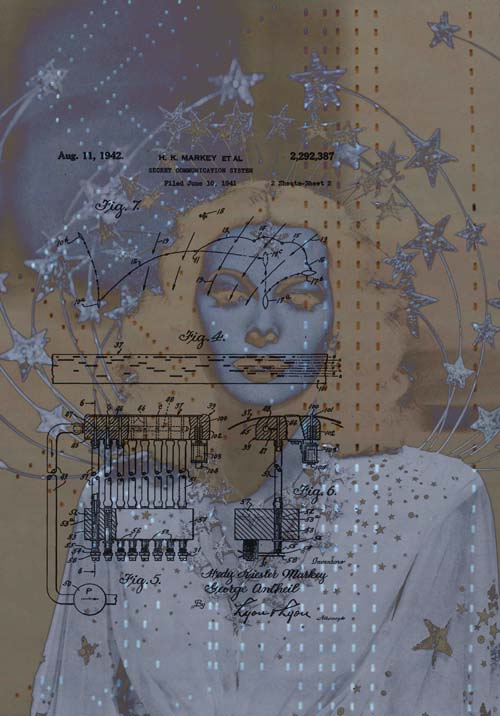
 Aura Satz, Impulsive Synchronisation, 2013
 The starting point for Impulsive Synchronisation is a 'Secret Communication System' patented during World War II by Hollywood star Hedy Lamarr and American composer George Antheil. This invention of 'frequency hopping' was designed to protect radio-controlled torpedoes from enemy disruption by distributing the signal over many frequencies and synchronising the transmitter and receiver in rapidly changing patterns. The idea, which drew in part on Antheil's unsuccessful attempt to synchronise 16 pianolas in his 1924 avant-garde masterpiece 'Ballet Mecanique', suggested the use of 88 frequencies (the number of keys on a piano), and the use of perforated paper rolls to keep the frequency hops in sync with each other. This concept has since become the basis for today's spread-spectrum technology, widely used in wireless telephone and wi-fi technology.
In this newly commissioned film and sound installation, these technologies are referenced to explore visual, musical and data notation, as well as its encryption, synchronisation and decipherment.The work consists of a scrolling screen made from five specially commissioned pianola rolls from Antheil's 'Ballet Mecanique'. The screen is in constant motion so that the film creates a complex light play from the encoded musical score, as the perforated strips of paper interact and produce patterns on the surrounding walls. In addition, a light located behind the screen - a kind of imageless echo of the projection lamp - flashes in systematic intervals, flattening the film-screen and highlighting the materiality of the pianola paper. At times the conflicting light sources overlap and cancel each other out. The film projected onto the scrolling screen is a very short extract from 'Come Live with Me', starring Hedy Lamarr. In this romantic comedy - premiered in 1941, the year she submitted the patent for her invention - Lamarr uses the metaphor of the flashlight, like a firefly, to attract a mate. In the film, the torch footage signals in flashes according to Morse code. The soundscape is composed of vintage underwater recordings of submarines and torpedo explosions from the 1940s, punctuated by the siren sections from 'Ballet Mecanique'.
'Impulsive Synchronization', solo show at Hayward Gallery Project Space, London
Talk with Curator Stephanie Rosenthal on Sunday 24 March, 3.30-4.30pm
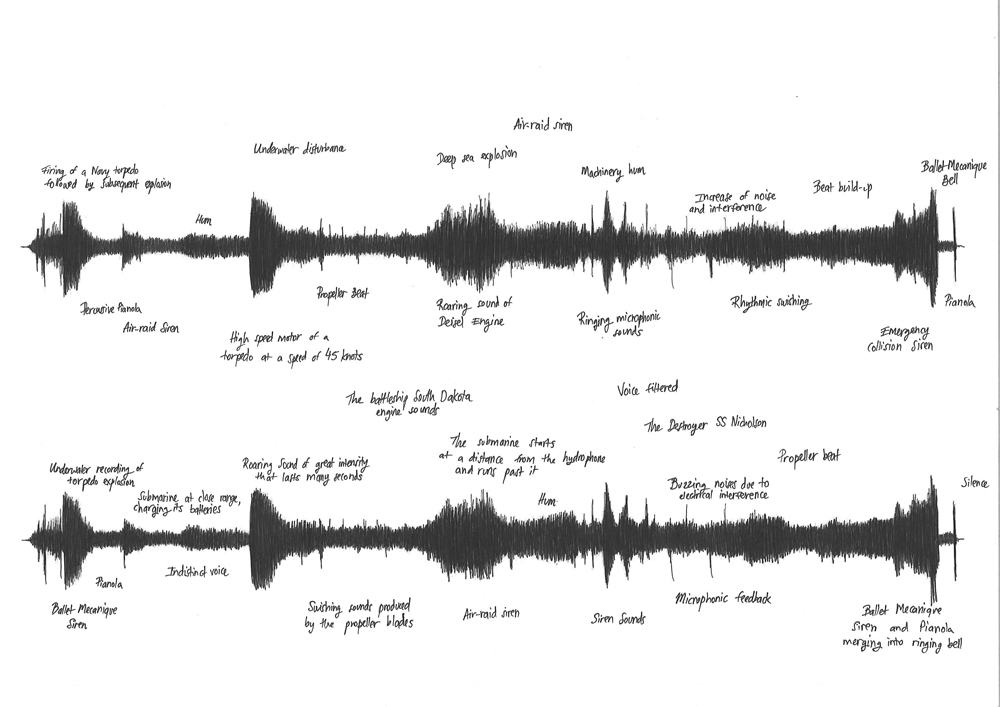 Aura Satz, Impulsive Synchronisation sound score, 2013