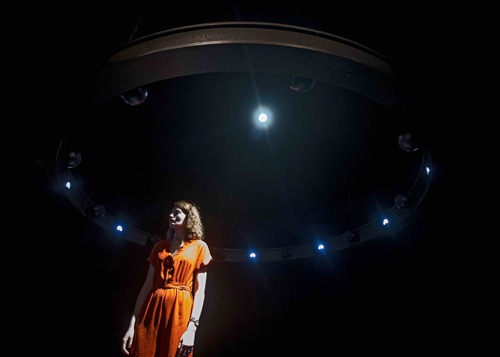
 Aura Satz, 'Tuning Interference: Dark Matter Radio', multi channel sound installation, 2019
 Tuning Interference on a Dark Matter Radio is a 10-channel sound installation which draws on the current quest to find the frequency of a dark matter wave. The project is inspired by the description of one of many Dark Matter research initiatives, as 'a radio that looks for a radio station, but we don't know its frequency. We turn the knob slowly while listening. Ideally we will hear a tone when the frequency is right.' Continuing Satz's investigations into sound as a trope for attending to the unsettled and unsettling, the project uses tuning and ever-changing recalibration as a compositional approach. In an echo of the open-ended and hypothetical state of current research, the project deliberately allows for patterns of interference and dissonance. The focus is on the fluctuating dynamic feedback loop between experimental listening, apprehending, and potential deciphering, as we reach towards the unfamiliar and unknown. The installation features a contained sonic environment in the shape of a ring that translates current Dark Matter simulations into sound patterns. The piece generates psychoacoustic effects in the listeners, exploring sonic equivalents of interference and collision through beat frequencies and other diffractive qualities which shift according to the listener's location. The listener becomes a radio dial of sorts, as the ears move through the soundscape microtuning with each adjustment. In between each of the 10 spherical speakers there are small VU metres, trembling to echo a volatile, dynamic and ever-changing frequency field, though what exactly is being measured is uncertain.
Nearby hangs a photo of Vera Rubin (1928-2016). Rubin was an American astronomer who discovered the galaxy rotation problem, providing evidence of the existence of dark matter. Here she is seen looking through a spectrograph mounted on the end of the telescope, recording an image of the spectrum (colors) of a small section of a galaxy. The image is framed inside a fresnel lens, generating a diffractive pattern emanating from the centre.
The project is the result of a collaboration between Aura Satz and cosmologists/astrophysicists Prof. Malcolm Fairbairn (Kings College London), Prof. David J. E. Marsh (Goettingen University) and audio engineer/music AI specialist Dr. David Ronan. Commissioned by the Science Gallery London, with support in kind from Gallo Acoustics. Built by Open Format. Original image of Vera Rubin, reproduced courtesy of Department of Terrestrial Magnetism, Carnegie Institution for Science.
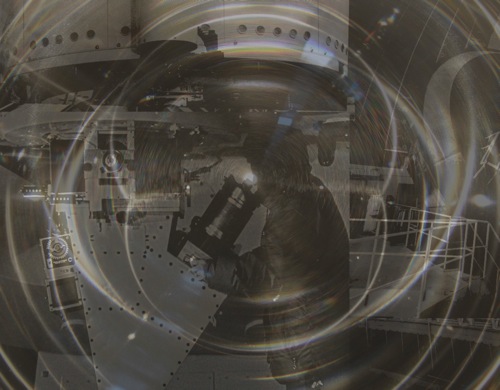 Aura Satz, 'Vera Rubin's Irrefutable Evidence', 2019
 Exhibtions
'Dark Matter: 95% of the Universe is Missing'
Science Gallery London, group show
In summer 2019, Science Gallery London will explore the elusive building blocks of the Universe with DARK MATTER, a free exhibition and events season combining art, physics and philosophy, and drawing on the latest research from the Faculty of Natural & Mathematical Sciences at King's College London. Exhibition highlights include an immersive animation installation by Andy Holden which reflects on the physics of a cartoon landscape, developed with Professor John Ellis from the Department of Physics at King's College London; translucent spider webs which mimic the structure of dark matter in the universe by Tomas Saraceno; a new installation translating dark matter simulations into sound patterns by Aura Satz, in collaboration with Professor Malcolm Fairbairn from the Department of Physics at King's College London; and; perpetually changing liquid crystal paintings by Agnieszka Kurant which will transform according to the 'energy' of social media feeds around the world. Curated by Sandra Ross.